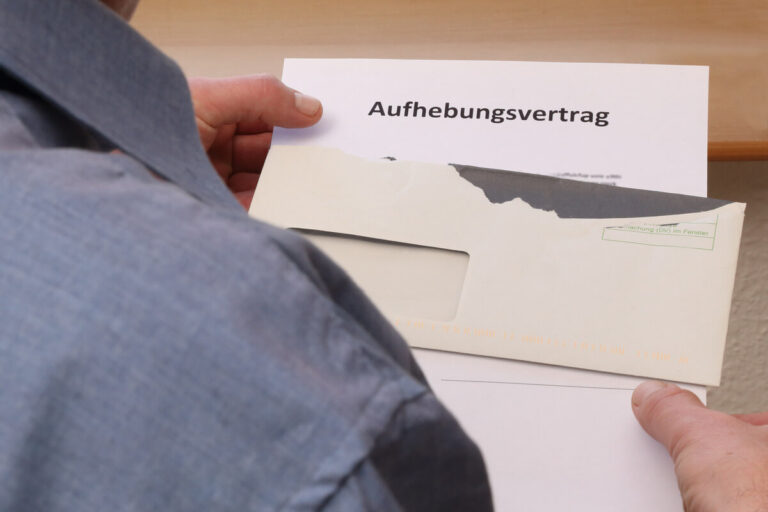
Employers must pay the salary after a dismissal until the ordinary notice period ends. This applies even if the employee is released from his work duties (Freistellung) or is on sick leave during the notice period. You will find answers in the following article, what employees can do if the employer simply refuses to pay the salary after dismissal, or if the employer offsets or demands repayment of wages allegedly overpaid.
Key points at a glance:
- If the employer refuses to pay the salary after a dismissal, the employee should first clarify the reason for non-payment. If an amicable solution is not possible, the employee should claim the outstanding amount in court or within agreed upon time-periods (Ausschlussfristen).
- If an employer has justified claims against the employee, he may not deduct these amounts in full. The employer is always required to pay the portion of the salary, which is exempted from attachment (Pfändungsfreibeträge).
- The employer may deduct an advance payment (Vorschuss) in full regardless of the attachment thresholds.
- If overpaid salary is reclaimed, employees can argue that they have already spent the money for ordinary costs of living.
Contents
Salary after dismissal
The employer must pay the salary until the ordinary notice period ends. This generally applies in case of release from work (Freistellung) or sick leave during the notice period. Only in case of a summary dismissal (fristlose Kündigung) the employment relationship ends with immediate effect, and with it the entitlement to salary.
Employees should first clarify the reasons
If the employer does not pay the salary after the dismissal or even demands repayment of wages (see below), the employee should as a first step clarify why the employer is not paying.
It is therefore always advisable to first read the pay slip carefully. It usually shows the breakdown of the salary and give some first clues for the non-payment. Employees can consult the HR department or the works council for support. Here are some examples:
- Incorrect pay slip: In many cases the non-payment is simply based on mistakes or misunderstandings. Therefore the employee should speak to the employer to clarify it. The works council can also help.
- Offset against outstanding claims (e.g. paid leave, settlement of missed working hours, claims relating to the return of work equipment, such as a company car, mobile phone or laptop). Even when claims are justified, the employer may only deduct certain amounts from the salary (see below in separate chapter).
- Offset against an overpayment (see below in “Reclaiming overpaid salary”).
- Offset against an advance payment (see below in “Reclaiming an advance payment”).
- Absence or illness without a timely sick note (Arbeitsunfähigkeitsbescheinigung). The employee must meet certain requirements in order to get paid sick leave (Entgeltfortzahlung).
- Alleged refusal to work: If the employer alleges that the employee refused to work, the employee should speak to the employer and submit any required records of working hours etc.
Employer does not pay salary after dismissal
If the employer simply stops paying the salary after the dismissal and a conversation with the employer does not help either, the employee should always claim the outstanding amounts in writing. The advantage: the employer takes the matter more serious, which often avoids further disputes. This can save the employee time, stress and additional costs.
Be aware of cut-off periods
In many cases employment contracts contain so called “cut-off periods” (Ausschlussfristen). Such a clause requires both parties to follow certain formalities within certain time periods in order to claim outstanding amounts. Here some examples for so called “one-step” and “two-step” cut-off period:
“All claims arising from the employment relationship must be asserted in writing within a period of three months from the due date. If this is not done, the claims expire.”
Employment contracts often contain a “two-step cut-off periods”:
“(1) All claims arising from the employment relationship must be asserted in writing within a period of three months from the due date. If this is not done, the claims expire.
(2) If the claim is rejected in writing or if no statement is made within one month after assertion, the asserted claim expires unless it is asserted in court within three months of the rejection or the expiry of the one-month period.” (two-step cut-off period)
Example: If an employee finds a two-step cut-off period in the employment contract, like the one in the example above, they must in a first step ask the employer with a simple letter to pay the outstanding salary:
“Dear …,
I hereby request you to pay my salary in the amount of €… gross for September 2025 immediately. The salary for September became due on 30 September 2025. The ordinary dismissal on 10 September 2025 with effect of 30 November 2025 does not change this. I demand the immediate payment of my salary plus default interest of 7.25% (5% above the base interest rate).
Yours sincerely
…”
The employee must make sure that this letter actually reaches the employer. He can hand over the letter in person and the employer must confirm the receipt on a copy. Alternatively, they can also send the letter by registered mail.
Second step: If the employer rejects payment in writing or does not respond within one month of receiving the letter, the employee must in the second step assert the claim in court within three months.
Legal proceedings in court
If the employer does not pay the salary after dismissal despite a proper out-of-court demand, the employee must file a claim for payment of the salary at the competent Labour Court.
Filing a claim at the Labour Court is straightforward. The court has a department, which assists you (Rechtsantragstelle) or a lawyer can support you. The usually faster “default-action procedure”(Mahnverfahren) is not advisable in this case. reason: if a cut-off period requires the claim to be asserted in court, the quicker “default-action-procedure” is not sufficient. Existing claims can expire.
Right of retention
Employees have a right of retention (Zurückbehaltungsrecht) if the salary is not paid after dismissal. This means: they can withhold their work without losing the right of payment for that specific period.
Before exercising this right, the employee should seek legal advice. Because if they exercise a right of retention without any justified reason, the employer may, under certain circumstances, issue a summary dismissal.
Employer demands repayment after dismissal
After a dismissal, employers often simply deduct claims or demand repayment of certain amounts. The employee should know the following:
Claims against the employee
If the employer has justified claims against the employee, such as the repayment of a loan, missing working hours etc., the employer can – of course – claim these amounts against the employee.
However, the employer may not deduct the full amount from the salary – even with justified claims. The employer is always required to pay the portion of the salary, which is exempted from attachment (Pfändungsfreibeträge). The employer may only deduct attachable amounts from the salary.1
The deductible amount follows a fixed table depending on the net income and the number of maintenance obligations:
- With a monthly net income of € 1,599, nothing may be attached or deducted by the employer.
- With a net income of € 2,000, the employer may deduct a maximum of € 311.50 (irrespective of maintenance obligations).
- With a net income of € 3,000, the employer may deduct € 1,011.50 (no maintenance obligations), € 429.89 (1 maintenance obligation) and € 213.49 (with 2 maintenance obligations).
- The amount in excess of a net income of € 4,766.99 is fully attachable.
If there is a dispute about whether and how much the employer may deduct, the employee must claim the salary in accordance with the agreed cut-off periods. If the employer still does not pay, the employee must file a claim at the Labour Court.
Overpaid salary
If the employer has accidentally paid too much salary, the employer can reclaim the payment after dismissal:
- However, employees can argue that they have already spent the overpaid salary for ordinary living costs (“loss of enrichment”: Wegfall der Bereicherung). The employee must prove this in court. For small and medium incomes, this proof is not necessary. Here, the courts assume that the employee has spent the overpayment for ordinary living expenses, provided it concerns minor overpayments.2
- Rule: The higher the overpayment in relation to the income, the less the court will assume that the employee has spent it for living expenses. The employee has to prove that. Example: An employee receives a monthly net salary of € 2,200, but the employer pays € 4,200 net instead.
- Exception: If the employment contract or collective bargaining agreement (Tarifvertrag) expressly provides for the repayment of overpaid amounts, the employee cannot argue that he has spent the money for living costs (Wegfall der Bereicherung).
Special case: advance payments
If an employee has received an advance payment (Vorschuss), the employee must either work for this payment or repay it to the employer when the employment contract ends.
Both parties must agree that an advance payment is a payment ahead of the salary and that it will be offset against the next pay slip.3 This constitutes the obligation to repay. The agreement on an advance payment can result from a separate agreement, an employment contract or a collective bargaining agreement.
The special feature of an advance payment is:
- Employees cannot argue that they have already spent the advance payment elsewhere (“no loss of enrichment”).
- The employer can deduct the advance payment in full from the next pay slip, regardless of the attachment thresholds.4
Caution with settlement clauses in termination agreements
If the employer does not pay the salary after dismissal, the employee must always make sure that the outstanding claims are part in any termination agreement (Aufhebungsvertrag). Termination agreements always contain settlement clauses (Erledigungsklausel) stating that “upon fulfilment of the claims in the termination agreement, all claims arising from the employment relationship expire“. If outstanding claims are not part of the termination agreement, the employee lose these rights.
Settlement clauses apply to employer claims against the employee in the same way. If the employer’s claim is not part of the agreement, the employer loses his claims as well.
Frequently asked questions (FAQ)
- §§ 394 BGB, 850 ZPO ↩︎
- BAG 23.05.2001, 5 AZR 374/99 ↩︎
- BAG 13.12.2000, 5 AZR 334/99 ↩︎
- BAG 13.12.2000, 5 AZR 334/99 ↩︎