Quelle: zuwanderung.sachsen.de
Losing your job while you are on a Blue Card in Germany can feel like your whole life in Germany and the EU is on the line. Your residence permit is tied to your employment, and deadlines start running the moment you receive a termination letter. Every decision – from signing a settlement to registering as a job seeker – has legal and immigration consequences now. However, you are well protected under German law and typically have plenty of options. Our guide explains what happens to your Blue Card (Germany) if you lose your job, which time limits you must meet, and how unemployment benefits, severance, and your right to stay interact. You will also learn which tactical options you have in negotiations so you can buy more time, protect your status, and avoid expensive mistakes.
Free initial consultation with a lawyer
Quick callback after 1 to 2 hours for a free initial consultation with a lawyer
Key takeaways
- Losing your Blue Card job is serious, but not the end: Protection against unfair dismissal in Germany is strong. You must act fast and consider employment and immigration law.
- After termination (or resignation) you must notify the immigration office (Ausländerbehörde), register with the employment agency (Agentur für Arbeit), and observe the three-week deadline to challenge the dismissal.
- You usually get only a limited window to find a new Blue-Card-level job or switch to another title. Use this time strategically (and prolong, where possible)
- In negotiations, focus less on “maximum severance” and more on “maximum runway”: a later end date or paid garden leave can be worth more than extra cash because it buys you lawful time to job-hunt and protect your residence status.
Contents
About the EU Blue Card
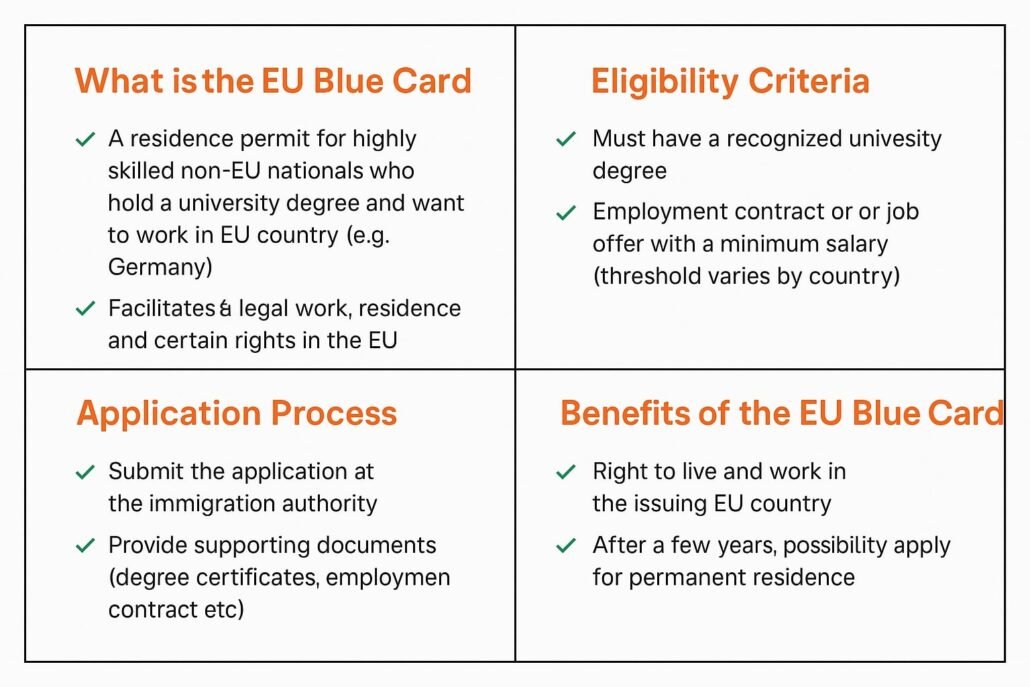
The EU Blue Card is a residence and work permit for highly skilled professionals from outside the EU who want to live and work in an EU country like Germany. Think of it as Germany’s “fast lane” for qualified talent: if you meet the criteria, you get a strong residence status with good mobility and long-term options. Key benefits include, for example:
- Favourable rules for bringing your family and changing employers.
- The right to live and work in Germany for the duration of your employment contract (plus a buffer),
- Easy travel to all EU countries in the Schengen Area without an additional visa,
- A faster track to permanent residence, and
- Favourable rules for bringing your family and changing employers.
General rules and requirements for the EU Blue Card
You typically qualify for the EU Blue Card in Germany if:
- You have a German university degree or a foreign degree that is formally recognised as equivalent in Germany.
- No classic university degree – Then you need a tertiary-level qualification (typically at least three years of training) that matches level 6 of the European Qualifications Framework or a comparable level.
- You already have a concrete job offer or employment contract in Germany that
- runs for at least six months,
- fits your qualification (and, if the profession is regulated, you hold the required licence or can show it is imminent), and
- reaches the legal minimum salary threshold for the Blue Card.
The official blue card (Germany) salary limits are adjusted every year and are published by the Federal Ministry of the Interior and Community as well as the Federal Employment Agency. The standard blue card (Germany) salary limit for 2025 is 48,300 EUR pre-tax per year.1

Free initial consultation with a specialist lawyer
- Free initial consultation with a lawyer
- Quick callback after 1 to 2 hours
- Strategy for negotiating the severance pay
Special EU Blue Card requirements for “shortage occupations.”
Germany is desperately looking for people in certain fields – the “bottleneck professions” (or shortage occupations – “Mangelberufe” in German). The blue card requirements in Germany (2025) are even less strict here, and a lower salary threshold applies:2 As of 2025, you can obtain an EU Blue Card with a minimum salary of €43,759.80 gross per year if:
- You work in a recognised shortage occupation and
- The Federal Employment Agency (BA) has approved your employment.
The “shortage list” is based on EU and German rules and includes:
- managers in manufacturing, construction, logistics and distribution,
- managers in IT and other information and communications services,
- managers in professional services (for example, childcare, healthcare, education),
- academic STEM professionals (science, technology, engineering, mathematics),
- academic professionals in architecture, urban and transport planning, and
- medical doctors, veterinarians, dentists, pharmacists and comparable health professions.3
If your profile fits one of these buckets and you hit the reduced salary threshold, your chances of a Blue Card are usually quite good – and this is exactly what German ministries and employment agencies explicitly encourage.
Special rules for IT professionals without a degree
Tech is a bit different. Under the reformed Skilled Immigration Act, Germany now officially allows experienced IT professionals to access the EU Blue Card without a traditional university degree. You may qualify as an IT professional or IT manager via the “experience route” if:
- You have a specific IT job offer in Germany with a contract of at least six months.
- The role pays at least €43,759.80 gross per year (the 2025 lower threshold for shortage occupations / IT).
- You can prove at least three years of relevant IT work experience within the last seven years at a level comparable to academic training and directly relevant to the job you will be doing in Germany.
If you tick these boxes, the authorities treat you like any other Blue Card holder. The legal basis is just work experience plus official guidance from ministries and agencies, rather than a framed diploma.
Blue card Germany salary 2025 checklist
| Category | 2025 minimum gross per year | Gross salary per month | Typical profiles |
| Standard EU Blue Card | €48,300 | ~€4,025 | Most highly skilled professionals (non-shortage occupations). Contract ≥ 6 months. |
| Shortage occupations (“bottleneck”) | €43,760 | ~€3,647 | STEM, doctors, architects, certain managers, etc. Requires approval by the Federal Employment Agency (BA). |
| IT professionals (experience route) | €43,760 | ~€3,647 | IT experts/managers, sometimes without a degree, ≥ 3 years relevant experience in the last 7 years. |
Application for an EU Blue Card in Germany
If you tick all the EU Blue Card (Germany) boxes and want to test the waters, start with the official pages right away. On the German Foreign Office website, you can check the requirements, see which documents you need, and start the visa process directly in most countries.
If Germany and your job are a good match, the Blue Card doesn’t have to stay “temporary”. In many cases, you can switch to a permanent residence permit after a relatively short time – roughly 21 – 27 months, depending on your German language level and social security contributions.
And the perks? The EU Blue Card (Germany) gives you a solid residence status, and easier family reunification. Also, it allows smoother employer changes after a while and relaxed travel in the Schengen Area. In short, it’s not just a work visa, it’s your on-ramp to a longer-term life in the EU (Schengen countries).
How easily can you lose your job when you hold a Blue Card in Germany?
Before we come to the question of what happens if you lose your job in Germany with a blue card, let’s first look at the question of how you can actually lose your job in Germany. In general, that’s a pretty high bar (for your employer). However, your protection depends on your period of employment:
During six-month probationary period
In Germany, there is a six-month probationary period with little job protection. The general protection under the German Employment Protection Act (KSchG), only kicks in after 6 months with the same employer. Until then, your employer can terminate you with the normal notice period without giving a detailed reason – as long as they don’t violate special protections (e.g., pregnancy, severe disability, works council membership) or anti-discrimination rules. In other words, in the first six months, it’s smart to play things pretty clean and by the book. How nervous you need to be really depends on your employer. And if you’re performing well in a shortage occupation, chances are they’ll bend over backwards to keep you rather than let you go.
After a six-month probationary period
Once you have completed your six-month probation period, you are no longer subject to arbitrary dismissal. If your employer has more than 10 employees, you are protected by the German Employment Protection Act (KSchG), which requires valid grounds for any termination to be deemed “fair.” There are only three categories of “fair” dismissals:
- Personal reasons: This refers to factors specific to the employee, such as prolonged illness, insufficient qualifications, or the loss of a necessary license (e.g., a driver’s license). The cases of valid terminations for personal reasons are rare!
- Misconduct: This occurs when an employee breaches their obligations. Examples include persistent refusal to perform tasks, theft, bullying, or repeated unexcused absences. Cases of valid terminations for conduct are even rarer!
- Operational reasons: Now, this is the biggest and most relevant group: “Operational reasons” are tied to economic or organizational shifts within the company, such as restructuring, or downsizing. However, strict requirements apply for operational reasons as well, which are hard to meet by the employer.
Read more about these categories in our dedicated blog post on the three categories for a legal and “fair” dismissal in Germany.
Extraordinary (immediate) dismissal
For EU Blue Card (Germany) holders, an extraordinary (immediate) dismissal is particularly serious because it ends the employment relationship without notice. It can immediately call into question whether the conditions for the Blue Card are still met, so the Ausländerbehörde may react faster and more critically. In practice, these dismissals are rare because German law sets an extremely high bar – typically requiring serious misconduct like theft, persistent refusal to work, or severe breaches of duty. Blue Card holders, as highly qualified professionals in stable positions, are much less likely to engage in such serious misconduct compared to the general workforce. However, caution is advisable when it comes to work time, holiday approvals, and working from abroad – those are typical “danger zones” for Blue Card holders.
Free initial consultation with a lawyer
Quick callback after 1 to 2 hours for a free initial consultation with a lawyer
Losing your job with an EU Blue Card: what you must do
If you are living in Germany on a Blue Card residence permit, your residence permit is linked to your employment contract. If you lose your job with an EU Blue Card, you have to manage three legal “construction sites” at the same time: (1) your duty to notify the Ausländerbehörde, (2) your deadlines with the Agentur für Arbeit and unemployment benefits, and (3) the three-week deadline if you want to fight the termination and negotiate severance. Missing any of these can cost you your residence status, ALG I or severance. And they all work together!
Notify the immigration office within 2 weeks
If your Blue-Card job ends earlier than expected (dismissal, termination agreement, resignation), you are legally obliged to notify the immigration office.
For residence titles issued for work or training, the law requires you to inform the immigration office (Ausländerbehörde) within two weeks after you learn about the early end of the employment.4 Your notification should contain:
- Full name, date of birth, nationality, and address
- Type and number of your residence title (EU Blue Card, § 18g AufenthG)
- Date you received the termination or signed the agreement
- Date the employment will end
- Copy of the termination letter/termination agreement
If you do not notify on time, the authority can fine you and may be less willing to extend or convert your residence title. A template letter can be found here – please send it by certified mail (Einwurfeinschreiben):
Register with the Agentur für Arbeit and protect ALG
Separate from immigration law, you must comply with social law deadlines – e.g., for registration as a job-seeker (“arbeitsuchend melden”) and unemployment (“arbeitslos melden”):
- If you know that your employment will end in more than 3 months, you must register as a job-seeker no later than 3 months before it ends.
- If you find out later than 3 months before the end date (typical case after receiving a dismissal), you must register within 3 days after learning about the termination.
You can usually do this online, by phone, or in person. Late registration can lead to Sperrzeiten (waiting periods/cuts in ALG I).
In addition, you must register as unemployed (“arbeitslos melden”) at the latest on your first day without work. The qualifying period (Anwartschaftszeit) is 12 months. You must have been in an insurance-obligatory employment for at least 12 months within the last 30 months before becoming unemployed (several jobs are added up). If you have less than 12 insured months, you normally do not get ALG I. However, you may have to look at Bürgergeld instead, which can be more sensitive for residence status.
Three-week deadline – if you want to fight your dismissal
If you want to challenge the termination and/or negotiate severance, you must observe the three-week deadline for a dismissal claim. You must file an unfair dismissal claim (Kündigungsschutzklage) with the labour court within three weeks of receiving the written notice of dismissal. If you miss this deadline, the dismissal is generally treated as legally effective, even if it was actually unlawful. For Blue Card holders, this is crucial because:
- a successful claim or a good settlement can extend the duration of the employment (e.g. longer notice, paid garden leave), and
- More time in a qualified job can make it easier to keep or convert your residence title.
More on this below in our more “tactical advice” for EU Blue Card holders. And in Berlin, this process can be started here.
Checklist for Blue Card holders who lose their job
| When (legal deadline) | What to do / where |
| Within 2 weeks after you learn about the job loss | Notify the Ausländerbehörde in writing that your Blue-Card employment is ending early and attach the termination letter/agreement. Contact the local immigration office responsible for your place of residence. |
| If the end date is > 3 months away: At the latest 3 months before it ends. If the end date is < 3 months away: within 3 days after you learn about the termination | Register as “arbeitsuchend” (job-seeker) with the Agentur für Arbeit (online, by phone or in person). |
| On or before your first day without work | Register as “arbeitslos” (unemployed) with the Agentur für Arbeit and apply for ALG I if you have at least 12 insured months in the last 30 months. |
| Within 3 weeks after receiving the written dismissal | Decide whether to file an unfair dismissal suit (in labour court), usually via an employment lawyer. |
Other options
- Blue Card holders who lose their job can switch to self-employment as an alternative residence path; this is a full switch, not a continuation of the Blue Card. Requirements include demonstrating economic viability, secured financing, and a detailed business plan.5
- Also, you can switch countries after a year: After 12 months of legal residence in the first Member State as an EU Blue Card holder,you are entitled to enter, reside and work in another EU Member State.
Important tactical advice for EU Blue Card Holders
In Germany, you are generally well protected against unfair dismissal, and many terminations end in a negotiated settlement – either in court or out of court. For most (EU) employees, the main objective is to maximise net severance pay. For EU Blue Card holders, however, there is an additional dimension: keeping your right to stay in Germany and gaining enough time to find a new qualifying job. The clock is ticking, as immigration authorities typically grant only a limited job-search period – often around three months, in some cases up to six months. And the job market is not as good as it was two years ago. We know a lot of people who are struggling to find a new job and a short period of time.
Different priorities for Blue Card Holders
In negotiations, your goal may therefore shift from “maximum severance” to “maximum runway”. Instead of insisting on the highest severance payment, it can be smarter to negotiate a longer employment period or an extended paid garden leave (Freistellung). Employers are often willing to trade part of the severance for longer continued employment because the overall financial impact for them is the same. For a Blue Card holder, though, this extra time can be crucial: it can turn a tight three- to six-month window into nine to twelve months of paid runway (and on garden leave) – plenty of time to secure a new job and protect your residence status in a difficult job market.
Frequently Asked Questions

Calculate severance pay now free of charge
- Calculate potential severance payment amount
- Strategy for negotiating a fair severance payment
- Find suitable lawyers for labour law