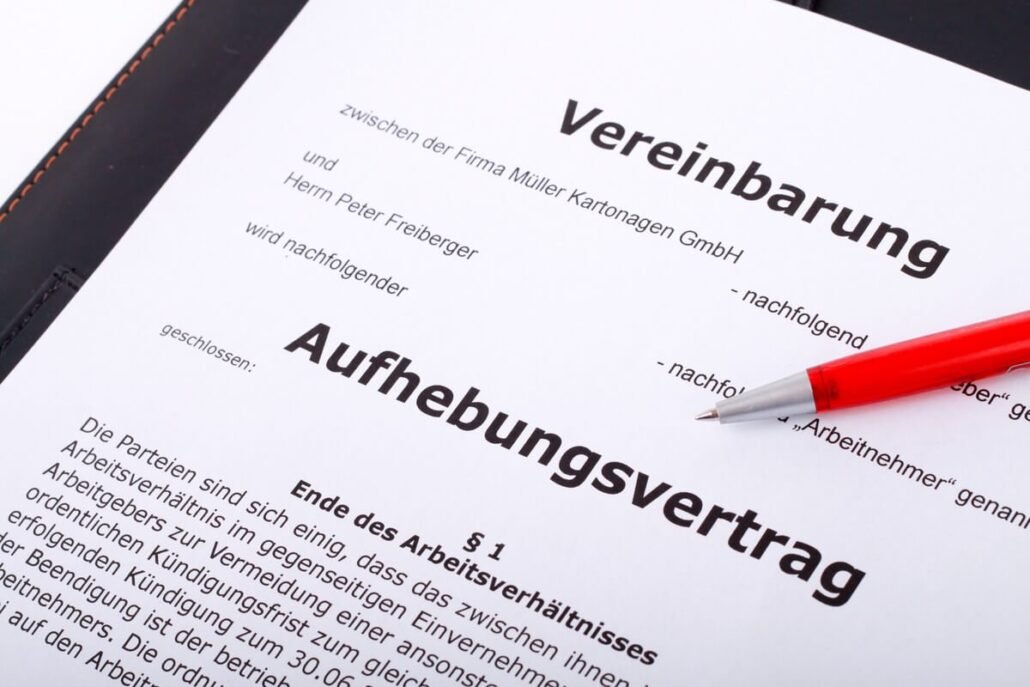
An early-exit or “sprinter” clause gives you the right to leave the company before the agreed-upon end date. And still receive your severance. If you use this option, your employer will often pay a “sprinter bonus”. This”bonus” reflects part of the salary “saved” by your employer between exit and termination date. In effect, this turns saved salary into an extra severance component. In can create a “double-benefit effect” if the employee finds a new job fast. Our article explains how a sprinter clause works. We also look at which advantages and risks the sprinter clause has for employees. Last, but not least, we analyze how good documentation and legal support can help.
Unfairly dismissed in Germany?
Check your severance pay now – you have only 3 weeks to preserve your severance package!
Key takeaways:
- A sprinter clause in a termination agreement lets you leave your job earlier than the agreed termination date without losing your severance.
- Often, the clause also includes a sprinter bonus: you receive part of the salary the employer saves – because you leave earlier.
- Upside: You can start a new job sooner without giving up your severance and may earn an additional bonus (from the saved salary).
- Bottom line: A well-drafted sprinter clause can increase both flexibility and the total value of your exit package.
Content
Content of a sprinter clause
A sprinter clause, sometimes also called “turbo clause” or “early-exit clause”, is often part of a termination agreements. It allows you to end the employment relationship before the termination date that the parties have agreed in the contract.
First, the employer and employee fix a regular future termination date. Until that date, you formally remain employed and are in many cases released from work with continued pay. On top of this, the parties agree on the “sprinter clause” in the termination agreement. It gives only the employee the right to leave earlier. If the employee uses the sprinter clause, you do not need to observe the usual statutory or contractual notice period. Instead, the agreement defines a shorter notice period for the early-exit declaration. So, for instance, you can align your last day with the start date in a new job.
The financial effect is that exercising the sprinter clause usually leads to a higher overall severance payment. The sprinter bonus typically corresponds to all or part of the salary that the employer saves between the actual exit date and the originally agreed termination date. It is added on top of the base severance.
If you find a new job before the agreed-upon end date, you can cash in most of your severance pay. As well as the salary from your new employer. This structure offers clear advantages for both sides, because you move on with a stronger package. And your employer gains planning certainty and may reduce ongoing payroll costs (a bit).
Do you need help with German labor law?
Get a free initial consultation now – with an expert on German labor law!
Benefits for employees
For employees, a well-designed sprinter clause can be one of the most valuable parts of a negotiated termination agreement. It increases flexibility and can significantly improve the overall deal compared with a simple lump-sum severance.
- A key benefit is a higher severance. If the employment ends earlier and you exercise the sprinter clause, the employer will often add the salaries saved to the severance as a sprinter bonus. In practice, this almost always leads to a higher payout than a standard termination agreement without an early-exit option.
- Another advantage is a possible double income for a limited time. You can start your new job before the original termination date. You still receive the agreed severance including the sprinter bonus. So for a transitional period you may receive both a new salary and a substantial lump-sum payment.
- From a tax and social security perspective, the sprinter bonus is part of the severance package. As a severance payment, it is usually exempt from social security contributions. Depending on the overall structure you may also benefit from favorable tax treatment of severance payments.
- A sprinter clause also supports flexibility and CV planning. You can take up a new position as soon as you find a suitable job before the agreed termination date. You avoid unwanted gaps in your CV, while still keeping the agreed release from work and the full severance package.
- Keeping all written offers, timelines, and emails in one place helps you stay on top of the details. And later prove what the parties agreed on if there is a dispute.
Benefits for employers
A sprinter clause in a termination agreement can also be attractive for employers. Especially in restructuring situations or where positions are being cut. It can make the separation process faster and more predictable for both sides.
- From a cost perspective, employers benefit from savings on salary and social security contributions. Severance payments, including the sprinter bonus, are usually not subject to social security contributions. So if you leave earlier, the employer saves its share of social security and the ongoing salary.
- In addition, a sprinter clause supports a faster separation. If the employer is reducing staff for operational reasons, an early, clean exit is often in their interest. A sprinter clause makes it easier for employees who have found a new job to leave early. If the bonus reflects only part of the saved salaries, the employer keeps the remaining “salary savings”.

Free initial consultation with a specialist lawyer
- 15min free initial consultation with a lawyer
- Prompt online appointment via Calendly or quick call-back
- Strategy for negotiating your severance pay
Sprinter clause and unemployment benefits
Exercising a sprinter clause in a termination agreement could, in theory, also affect unemployment benefits. The impact depends on the case and on whether you already have a new job when you use the clause:
If you use a sprinter clause without having a new role and then apply for unemployment benefits, the German Employment Agency can order that your entitlement to benefits rests for a certain period:
- This would mean that the sprinter bonus is partially offset against unemployment benefits.
- In reality, this scenario is rare. Most employees only exercise the sprinter clause once they have signed a new employment contract.
In case you are thinking about an early exit without a firm new job, you should obtain legal advice. Clarify how the termination agreement and sprinter clause affect the timing and amount of unemployment benefits. If there is a termination, remember that you usually have only three weeks to file a claim against an unfair termination, so timing and coordination really matter.
Formal requirements for using a sprinter clause
When you exercise a sprinter clause in a termination agreement, strict formal requirements apply. The Federal Labour Court has held that the employee’s early-exit declaration is legally a notice of termination, even if the parties use a different label.
This means that the declaration must comply with the written-form requirement for terminations.1 An oral statement, an email, a text message or a fax is not enough and does not end the employment earlier.
You must submit a written, signed original declaration in good time before the desired early-exit date and should keep proof of receipt, for example, a written acknowledgement from the employer. If this is not done correctly, the employment ends on the originally agreed date in the termination agreement and any claim to the sprinter bonus can be lost, so careful documentation of timing and delivery is essential.
Legal advice on a sprinter clause
Because a sprinter clause often involves several months of salary, we recommend professional legal advice. Mistakes in drafting or exercising the clause can quickly cost more than a short consultation with an employment lawyer or a legal tech service that works with specialist attorneys.
In theory, you could negotiate and draft a termination agreement and a sprinter clause on your own. In practice, employment law is technical, and the financial stakes are high, so specialist support is usually the safer route, especially where there has also been a dismissal and tight court deadlines are running in the background.
It is also worth checking whether legal expenses insurance is already in place or could be arranged before a conflict escalates, because many policies only cover employment disputes after a waiting period and do not help if a termination is already on the table. With or without insurance, an experienced lawyer can help structure the sprinter clause, coordinate timing with the new employer and reduce the risk of later tax or unemployment-benefit issues.
Free initial consultation with a specialist lawyer
- 15min free initial consultation with a lawyer
- Prompt online appointment via Calendly or quick call-back
- Strategy for negotiating your severance pay
Sample sprinter clause
Below is an example of a sprinter clause that you can include in a termination agreement. Important that you review and adapt it to the specifics of the individual case.
“The employee has the right to terminate the employment relationship early. Termination must be declared with a notice period of one week by means of a unilateral termination declaration that must be received by the employer. Once the termination declaration has been submitted, all legal consequences under this agreement that are linked to the end of the employment relationship take effect at the earlier termination date. The severance payment agreed in clause [.] increases by [.] euros for each full month of early departure, and on a pro rata basis for partial months based on a 30-day month (the sprinter bonus). The severance payment and the sprinter bonus fall due for payment at the end of the month following the month in which the early termination was declared.”
Frequently asked questions (FAQ)
Free initial consultation with a specialist lawyer
- 15min free initial consultation with a lawyer
- Prompt online appointment via Calendly or quick call-back
- Strategy for negotiating your severance pay
- Section 623 German Civil Code ↩︎