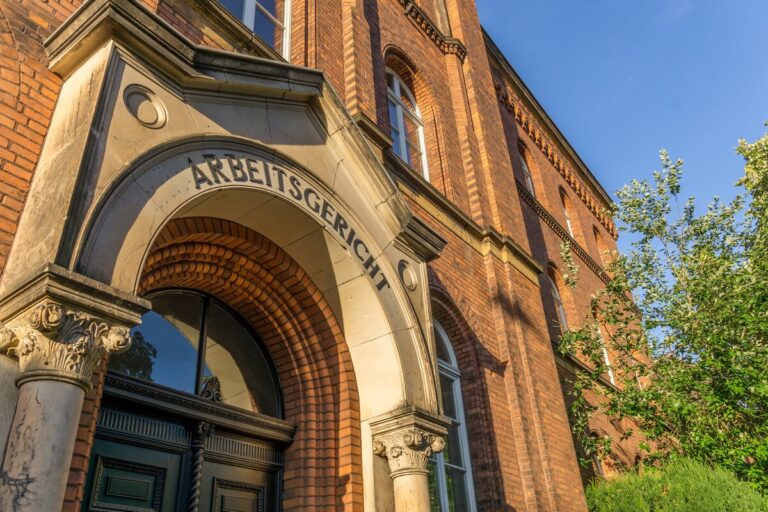
Many employees believe that they cannot be dismissed while they are on a rehabilitation programme (Reha or Kur). That is only partly true. Rehabilitation does not create any special protection against dismissal. A dismissal due to illness during an ongoing rehabilitation programme often fails, because the employer cannot yet prove the negative health prognosis for the future. This article explains when a dismissal during a rehabilitation is possible and the rights of an employee.
The key points:
- Participation in a rehabilitation programme alone is not a reason for a dismissal. The employer must have other reasons for a valid dismissal.
- During rehabilitation there is no additional special protection against dismissal:
- The employer may only terminate the contract in compliance with general rules (dismissal related to sickness, misconduct etc.) and if applicable with other specific protection rules (disability etc.)
- For a dismissal due to illness, the employer has to prove a negative health prognosis at the time of the dismissal, which is not possible during an ongoing rehabilitation. The employer therefore has to wait for the outcome of the rehab.
- After a rehabilitation the dismissal follows the general requirements.
Contents
No dismissal because of rehabilitation
A rehabilitation programme1 must be approved by a social insurance provider (the pension, health or accident insurance fund). Only then the participation alone is not a reason for dismissal.
Before the rehab starts, the employee must inform the employer without delay about the start, the duration and the approval of the programme, and submit an official certificate by the insurer.
No additional protection during a rehabilitation
On the other hand, employees do not enjoy any additional special protection against dismissal while they are in rehabilitation. If the Protection Against Dismissal Act (KSchG) applies (employment is longer than six months and the business employs more than ten employees), the employer can issue a dismissal related to misconduct, a dismissal on operational reasons (business restructuring) or a dismissal with the offer of altered terms (Änderungskündigung).
Special hurdles for a dismissal due to illness
The general principles for a dismissal based on illness apply. There are three main requirements:
- there has to be a negative health prognosis, which
- leads to significant disruption to the business, and
- the employer’s interests have to outweigh the employee’s interest in continuing the employment relationship.
Why do many dismissals fail during rehabilitation?
The difficulty during an ongoing rehabilitation programme is proving a negative health prognosis for the future. The employer has to prove that at the time of the dismissal the employee will not be able to perform his work in future and will be absent from work for more than six weeks a year. While rehabilitation is still on, the employer will not be able to prove that as the whole point of the rehabilitation is to restore the employee’s health and ability to work. Therefore the courts require the employer to wait for the end of the rehabilitation and it’s outcome.
Example:
An employee participates in a therapy due an alcohol addiction. The employer must wait for the end of the therapy to be able to prove if there is a negative health prognosis or not. An earlier negative health prognosis can only be established once the employee either refuses therapy or has relapsed despite completing therapy.2
Example:
An employee takes part in a three-week rehabilitation programme because of an injured disc. The aim of the programme is to restore the ability to work. As long as the outcome of the rehabilitation is uncertain, the employer will not be able to argue that significant absences will happen in future.
Note: The absence caused by the duration of the rehabilitation cannot be used to support a dismissal due to illness. This absence does not allow any conclusions for future absences (negative health prognosis) as it’s sole purpose is to avoid future absences.
Dismissal after rehabilitation
When the employee comes back from rehabilitation, there is usually a meeting, in which all the different future work options will be discussed. This is part of a statutory Integration Management Programme (BEM). The details depend on the rules of the individual employer. The meeting is an opportunity to discuss whether and how the employee can be reintegrated into the workplace. Depending on the individual health situation, a phased return to work is also an option.
Employees should discuss this with their medical practitioners (for the medical side) and with a lawyer specializing in employment law (for the legal issues). They can also get in touch with their trade union or other advice centers.
If absences continue and point to a negative health prognosis, the employer can issue a dismissal due to illness, provided it complies with all the requirements of the Protection Against Dismissal Act as discussed above.
Frequently asked questions (FAQ)
- Officially, the law refers to “preventive and rehabilitative measures.” The purpose of these measures is to prevent illness (prevention) or to restore health after an illness (rehabilitation). In this article, we also use the German term “Kur”, for which there is no direct translation in English. ↩︎
- Federal Labour Court (BAG) 20.3.2014, 2 AZR 565/12 ↩︎