
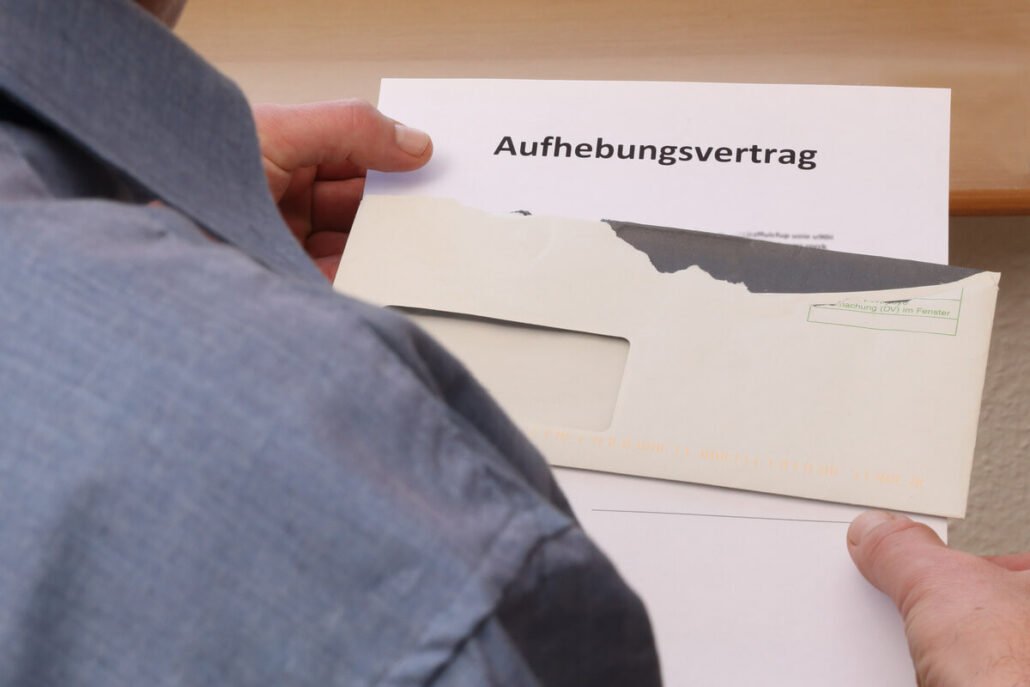
Many employees sign termination agreements without carefully checking the “final settlement clause” (Erledigungsklausel). This often results in a significant loss of money as with a settlement clause all existing and future claims between employer and employee expire. The purpose of a settlement clause is clarity, but it can lead as well to significant financial consequences, depending on which claims the employee had before signing the agreement (for example commissions, bonus payments etc.). This article explains the contents and effects of settlement clauses as well as their advantages and disadvantages.
The key points at a glance:
- Final settlement clauses are standard clauses in termination agreements. Once the parties have fulfilled their duties in terms of the termination agreement, the settlement clause usually regulates that all claims between employer and employee are “settled” (ceased).
- Content and consequences: Before signing a termination agreement, employees have to check carefully, which claims still exist and must incorporate them in the termination agreement.
- Claims that cannot be waived: There is a range of claims that an employee cannot give up in a final settlement clause (Examples: statutory annual leave, minimum wages etc.).
- Judicial review: Standard settlement clauses can be invalid if they are unclear, incomprehensible or unreasonable.
Contents
The content of a final settlement clause
Final settlement clauses are always part of termination agreements, dissolution- or winding up agreements. They are meant to create clarity about which claims still exist and which are “settled”, meaning ceased to exist. The aim is to avoid follow-up disputes once the employment relationship has ended.
Final settlement clauses are also referred to in German as “Ausgleichsklausel”, „Ausgleichsquittung” oder „Abgeltungsklausel“:
Examples of final settlement clauses
“§… Final settlement clause
The parties agree that, once the claims set out in this contract have been fulfilled, no further claims arising from or in connection with this employment relationship exist, irrespective of their legal basis.”
Example for a limited scope
“§… Final settlement clause
The parties agree that, once the claims set out in this contract have been fulfilled, no further claims arising from or in connection with this employment relationship exist, on whatever legal basis. The following claims are excluded: (specific list of claims, for example “claims arising from a post-contractual non-competition clause” or “the claim to a qualified reference letter”)”
A more detailed provision
“§ … Final settlement clause
The parties agree that, once this agreement has been fulfilled, all known and unknown mutual claims arising from this employment relationship and its termination are discharged. This settlement clause does not cover the employee’s claims to
- commission, profit share, annual special payments or year-end payments
- contractual annual leave pay or additional holiday allowances
- a qualified reference letter (certificate of service)
- compensation for a post-contractual non-competition etc.
and the employer’s claims to
- payment of …… (for example under a loan agreement)
- return of the …”
Note: Employees should wait with signing final settlement clauses when their notice periods are longer and they are not released from their duties up to the end of the notice period. The reason: further claims might arise up to the end of the notice period.
Claims that cannot be waived
The employee cannot waive certain claims even if they are part of a settlement clause. Here some important examples:
- Statutory minimum annual leave pay and the claim to payment in lieu of untaken leave1
- Claims to continued pay during sickness2
- Minimum wage claims (only in a court settlement)3
- The claim to a reference letter (Arbeitszeugnis). A waiver is only possible if it is expressly included in the settlement clause4
- Company pension claims
- Claim to return of company property (company car; laptop and similar)
- Claims under a collective bargaining agreement (Tarifvertrag): waiver only with the consent of the parties to that agreement.5
- Claims under a works agreement (Betriebsvereinbarung): waiver only with the consent of the works council.6 A works agreement can include claims to commission, overtime, company benefits etc.
- Claims arising from employee inventions. 7
A mere “acknowledgement of receipt”
There is no final settlement clause when the document merely acknowledges receipt of something. Here an example:
“The employee confirms receipt of …”
The employee just confirms receipt of something and does not waive any claims. But the employees must carefully check whether the document only confirms receipt and that the small print does not say anything else.
Consequences of a final settlement clause
All claims cease after fulfillment of the termination agreement, which includes an unlimited settlement clause.
The employer has no legal duty to explain that to an employee.
Invalid settlement clauses
If there is a dispute between the employer and employee on the content of a settlement clause, the basic principle applies that if there is any doubt, the claim was part of the settlement clause.
But Courts can check settlement clauses. The clause must be clear, comprehensible and reasonable.8 They must not cover only the employee’s claims. There must be a balance between the interests of the employee and employer. Where waiver clauses breach these principles, they might be invalid.
Advantages and disadvantages of final settlement clauses
For employees and employers final settlement clauses have the following advantages:
- Avoiding legal disputes: settling all claims can prevent potential conflicts and long legal proceedings.
- Legal clarity: the parties clearly define which claims exists or not.
- Certainty for planning: Employee and employer both know that no further claims exist. That creates certainty for future planning.
For employees in particular, they can also bring the following disadvantages:
- Giving up claims: by signing a final settlement clause too hastily, employees may give up existing claims unknowingly.
- Lack of legal advice: employees often sign final settlement clauses without taking legal advice first. It is always helpful to consult a lawyer.
- Pressure to sign: Employer often put time pressure on the employees. Employees should always ask for reasonable deadlines which gives them time for legal advice and reasonable decisions.
- No renegotiation: with a valid settlement clause the party cannot bring further claims at a later stage.
Frequently asked questions (FAQ)
- Section 13 subsection 1 Bundesurlaubsgesetz (BUrlG); BAG 14.05.2013, 9 AZR 844/11 ↩︎
- Section 12 Entgeltfortzahlungsgesetz /EFZG ↩︎
- Section 3 Mindestlohngesetz (MiLoG) ↩︎
- BAG 16.09.1974, 5 AZR 255/74 ↩︎
- Section 4 subsection 4 Tarifvertragsgesetz (TVG) ↩︎
- Section 74 subsection 4 Betriebsverfassungsgesetz (BetrVG) ↩︎
- Section 22 Arbeitnehmererfindungengesetz (ArbnErfG) ↩︎
- BAG 21.06.2011, 9 AZR 203/10 ↩︎